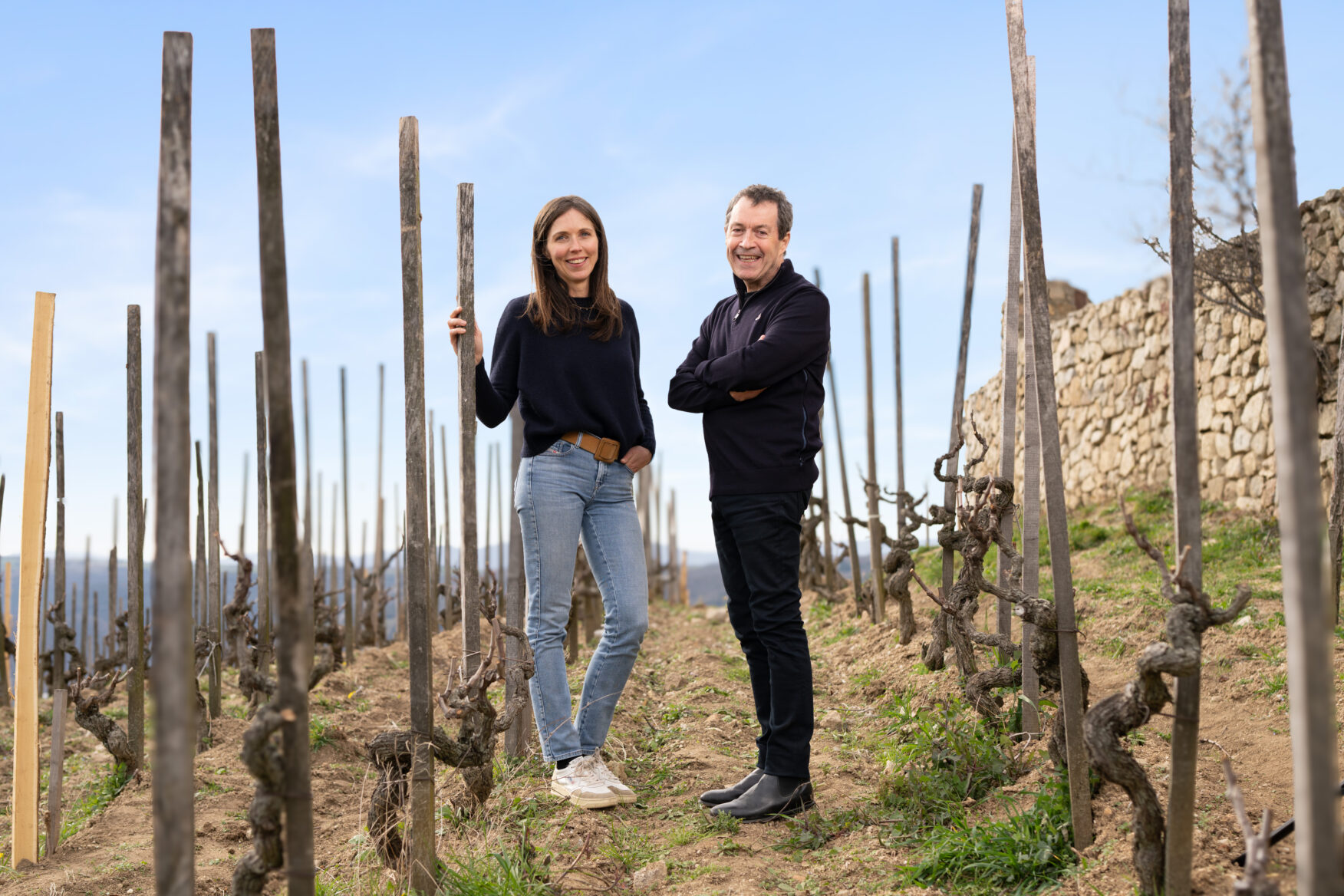
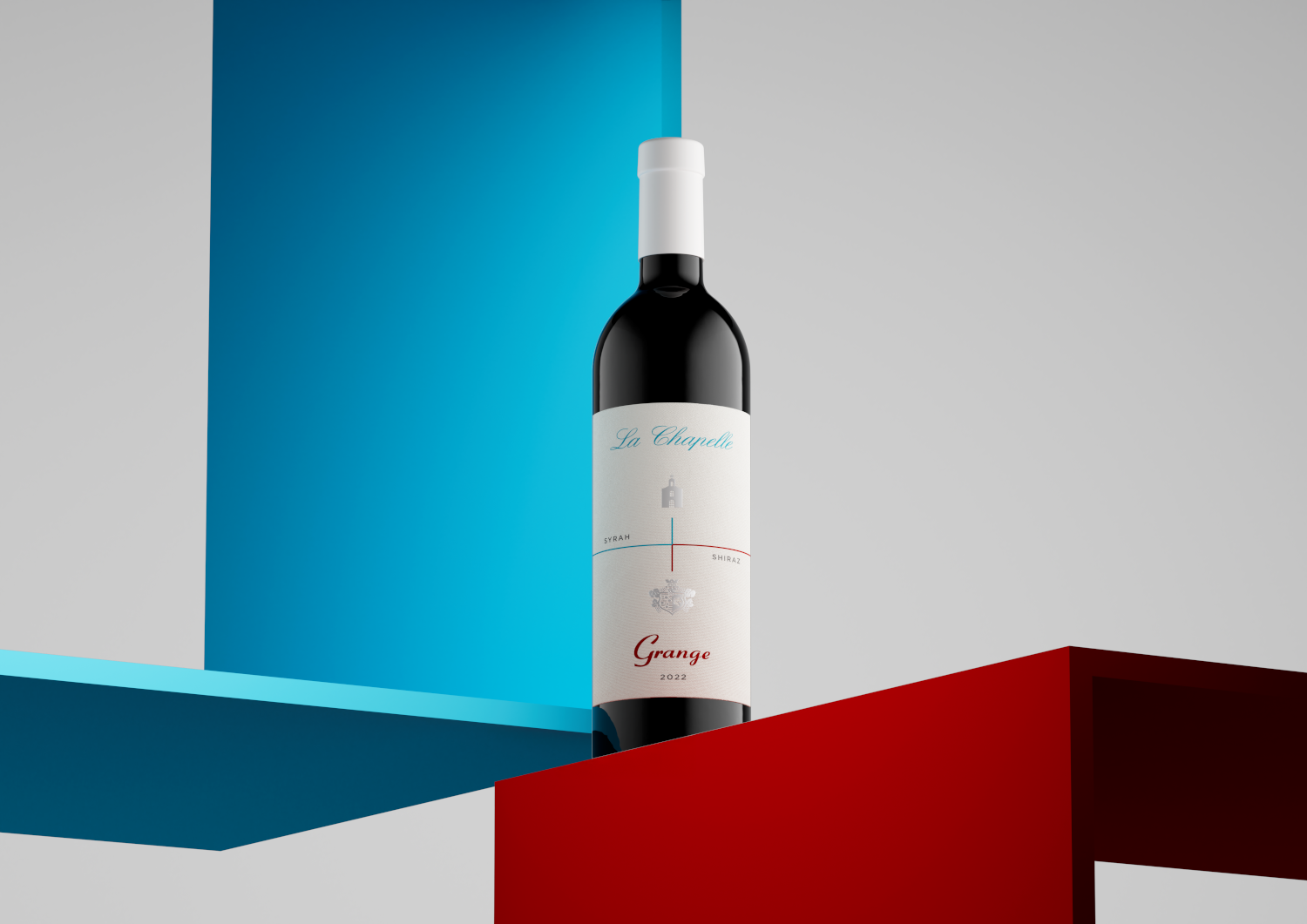
The release of 2021 Grange La Chapelle, a blend of Penfolds Grange Shiraz and Hermitage La Chapelle, will raise worldwide interest among wine collectors and fine wine observers. Mooted as ‘sans précédent’, the wine promises to create conversations and intrigue. But it will not be the first time that wine lovers have imagined these two famous wines as a blend. At the end of comparative tastings in years past, it was sometimes irresistible to see what a table-blend of Paul Jaboulet Hermitage La Chapelle (as it was known until recently) and Penfolds Grange Shiraz would look like, but the results were always transient and inexact!
When I initially heard about project ‘crochet’ last year, it brought back memories of times past and a feeling that history had come the full circle. The historical and romantic links between the Rhone Valley’s Hill of Hermitage and Australian Shiraz are profound. Many of South Australia’s oldest surviving vineyards are based on genetic vinestock material first brought into New South Wales in 1832. And Hermitage La Chapelle and Grange epitomise the modern syrah/ shiraz aesthetic.
When I tasted 2021 Grange La Chapelle for the first time late last year, I was captivated and fascinated. The wine is beautifully assembled (in South Australia) with the richness and volume of Grange offset by the aromatic complexity and purity of La Chapelle. With its blackberry pastille, raspberry fruits, roasted chestnut, brambly notes and fragrant white pepper nuances, the bouquet is beguilingly animated and everchanging reflecting a near-perfect balance of ripeness and cool-climate vibrancy. The saturated and lithe palate is refined and polished with pure blackberry, dark chocolate, touch peppery fruits, underlying roasted chestnut marzipan, nutmeg nuances and loose knit slinky tannins. It finishes chalky/ peppery with attractive dark/ red berry fruits and hints of aniseed. The blend works brilliantly well offering something different and evocative. Although it is a beautiful wine to drink now, it behoves further cellaring but there is an element of unchartered waters. Will the two components remain synchronised? In the end that’s a part of the magic of aging wine. (Drink now – 2050+, 14% alc, 98 points)
When I tasted 2021 Grange La Chapelle for the first time late last year, I was captivated and fascinated.
The 2021 Grange La Chapelle or 2021 La Chapelle Grange is a 50%/50% blend of 2021 Hermitage La Chapelle, sourced from lieu-dits (vineyard plots) surrounding the Hill of Hermitage (Rhone Valley France) and 2021 Penfolds Grange Shiraz, a multi-vineyard South Australian blend based on mature to ancient 19th Century-planted vines in the Barossa Valley, McLaren Vale and Clare Valley. Typically Grange is matured in 100% new American oak hogsheads, while Hermitage La Chapelle is aged in 20% new French oak barriques and amphora. Each component seems to bring out the best of its blending companion. While Grange gives volume, generosity and warmth, La Chapelle brings lift, purity and spring. Neither component dominates resulting in a wonderful expression of syrah/ shiraz. The recommended release price for this rare cuvée is $3,500 AUD or €2,600 Euro per bottle.
Grange La Chapelle represents the essence of ambition and modernity. And historically Penfolds Grange Shiraz and Hermitage La Chapelle share fascinating connections. This essay brings the strands together. Grange La Chapelle is a wonderful expression of savoir faire, inventiveness and imagination.
The interlinking histories of La Chapelle and Grange
In early December 1831 James Busby, an ambitious colonial administrator from the colony of New South Wales, arrived in the Rhone Valley with the purpose of observing vineyard practices and collecting grape vine cuttings for aspiring colonial vignerons. A few months earlier he had disembarked at Cadiz to begin his fateful tour of Spain and France. Over the following four months he amassed upwards of nearly 600 grape vines directly from privately-owned vineyards, the Luxembourg Gardens in Paris and the Botanic Gardens at Montpellier. In addition, he collected 44 vine cuttings from the Duke of Northumberland’s grape vine nursery at Sion House, ten miles west of London. The Busby importation, which arrived at Sydney Cove in January 1832, would form the foundation of Australia’s fine wine industry and foreshadow the enterprising ambitions of the Penfolds family some 12 years later in 1844. Although Busby did not bring in the first shiraz (described as red hermitage) vines to New South Wales, nothing is really known of the 1830 importation by Alexander Riley or its exact provenance.
After arriving at Tain L’Hermitage, on the left bank of the south-flowing Rhone River, James Busby presented his letters of introduction to Mssrs Richard et Fils, a firm of negociants and bankers at Tournon (on the opposite bank) which could be accessed by a pedestrian suspension bridge, built in 1824. Mssrs Richard et Fils also possessed sizeable holdings of vineyards on the lesser slopes of the Hill of Hermitage and surrounds. In addition, it owned the largest press in France. According to one observer ‘by one charge of it the proprietors can obtain forty casks of wine of about 50 gallons each.’ This company was also engaged in supplying the bulk of its wines to negociants in Bordeaux. It was typical for the wines to be around 4-5 years old before casks were exported.
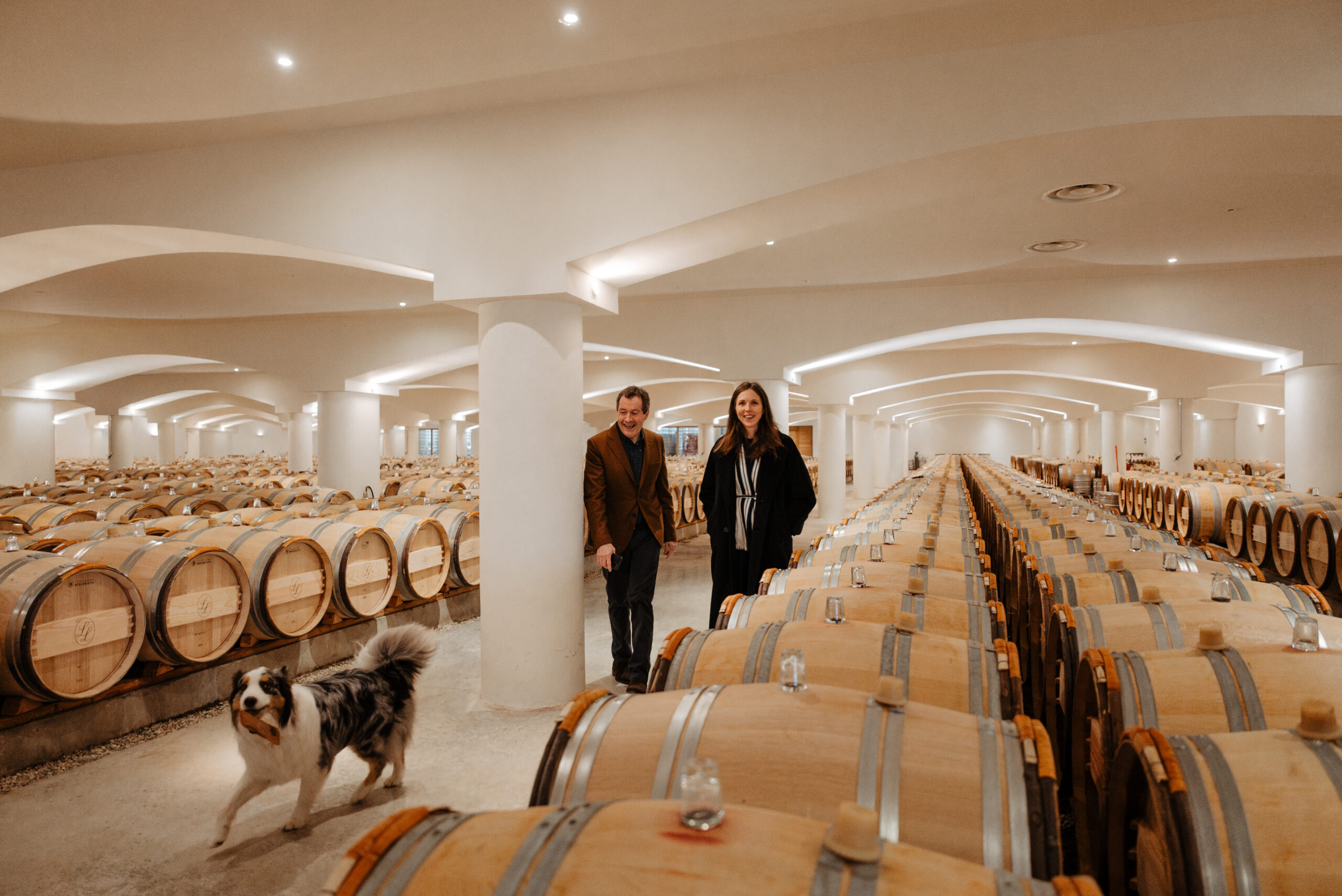
Blending the richly flavoured and densely concentrated red wines of Hermitage with Bordeaux’s grand cru château wines was a common practice during this time. In Cyrus Redding’s ‘A History and Description of Modern Wines (1833), he mentions that ‘it is styled by the French, the richest coloured in their great variety of wines’. This also translates to richly flavoured wine with substantial tannins requiring cask-aging to allow the wines to settle and develop. No wonder Hermitage was shipped in vast quantities to bolster up many of the highest quality estate clarets of the time. For instance, 1795 Ch Lafite, which comprised Hermitage in its blend, was ‘the best liked wine of any of that year.’ Nonetheless the best white and red wines from the Hill of Hermitage were also greatly prized for their individual qualities. For instance the Hermitage wines based on Marsanne and Roussanne were considered by wine merchants as ‘the finest all white wines’ with a keeping quality of over 100 years. And Hermitage, based on syrah, rivalled the best wines of Pauillac and St Julien in Bordeaux; with the added irony that many of these estates blended a large proportion of ‘the finest red wine of hermitage’ into their wines. Throughout the 19th Century the practice of ‘hermitaging’ or ‘hermitagé’ was widely admired and encouraged to improve the quality of Bordeaux Claret. Customers were happy to pay a premium for these deeply coloured, richly flavoured and tannic wines. James Busby wrote in his travelogue ‘the greatest part of the finest growth is sent to Bordeaux to mix with the first growths of Claret’. A Tour through the Finest Vineyards of Spain and France (1833) was published in Sydney but was also syndicated into other English-speaking publications; bringing new perspectives to the culture of wine. According to James Busby’s enquiries, around 80% of wine production in Hermitage at this time was shipped to Bordeaux for this purpose. Multi-regional blending was commonplace in Europe during the 19th Century and would continue into the phylloxera crisis era of the mid-to-late 1800s. In the Australian colonies multi-vineyard sourcing and blending became standard practice as the massive export boom of red wine gathered pace in the 1880s and 1890s.
Commercial opportunities to supply bulk wine for the Bordeaux wine trade also led to the establishment of a small winemaking enterprise by local vigneron Antoine Jaboulet in 1834. Born in the village of Cornas in 1807, he was a near contemporary of James Busby, but it is unlikely the pair would have met in 1831. Spending only a few days in Tain L’Hermitage, Busby was taken by his sponsors ‘to visit one of the largest proprietors of the part of the hill of Hermitage, which produces the best wines’. On this expedition into the steep hillside vineyards it is likely James Busby walked up to the ancient ruins of La Chapelle in 1831 to enjoy the spectacular view. He wrote, ‘The hill of Hermitage is so called from an ancient hermitage, the ruins of which are still in existence near its top. It was inhabited by hermits till within the last 100 years. The hill, though of considerable height, is not of great extent; the whole front which looks to the south may contain 300 acres, but of this, though the whole is under vines, the lower part is too rich to yield those of the best quality, and a part near the top is too cold to bring its produce to perfect maturity.’
Monsieur Machon, who accompanied James Busby through his vineyards, showed him a belt of calcareous soils that transitioned across the ordinary granitic soil of the mountain. James Busby recorded Machon saying that ‘it requires the grapes from these different soils to be mixed, in order to produce the finest quality of Hermitage.’ Busby also noted that the red wines were made exclusively from Ciras (sic) also spelled Scyraz in the 1827 edition of M. Jean-Alexandre Cavoleau’s Oenologie Francaise. At the time of Busby’s published travels through France, local vignerons in the Hermitage environs believed ‘the plant was originally brought from Shiraz in Persia by one of the hermits of the mountain.’ Although this legend is proven not to be true, the romance surrounding Hermitage La Chapelle will forever be associated with the grape variety known by the French as syrah and by Australians as shiraz (or the synonym Hermitage until the early 1980s).
The English-speaking Monsieur Machon, a significant vineyard proprietor and negociant of Irish descent, ordered ‘his vigneron’ to give James Busby 12 cuttings each of ‘Scyraz, Marsan and Roussette (sic),’ from younger vines (5-6 years old) (from the slopes of the Hill of Hermitage) in the belief that the vinestock material would survive for much longer than cuttings from older vines. It was typical of vignerons to layer vines in the vineyards and as a consequence the cuttings would have been sourced within well-established blocks. James Busby was delighted with this outcome and assured his sponsor Monsieur Richard that he would ‘give his countrymen the credit to which they were entitled’ should an account of his journey be published.
…the romance surrounding Hermitage La Chapelle will forever be associated with the grape variety known by the French as syrah and by Australians as shiraz (or the synonym Hermitage until the early 1980s).
James Busby’s visit to Tain L’Hermitage and surrounding vineyards lasted just four days (10th-14th December 1831), but the scyraz cuttings he collected from M. Machon would form the foundation of the Australian wine industry’s success. It is conjecture but more than possible that these young vine cuttings came from Bessards, Le Meal or Les Greffieux, the same vineyards that are inextricably associated with Hermitage Domaine de La Chapelle. But at this time the wines from these plots were substantially ‘doctoring’ Bordeaux’s first growth claret, with only some parcels exported as Hermitage for wine merchants.
When James Busby’s scyraz cuttings arrived at Sydney, New South Wales in January 1832, they were shared between Sydney’s Botanical Gardens, the Busby Family’s Kirkton Vineyard in the Hunter Valley and the Macarthur Family’s Camden Park, southwest of Sydney. This genetic material, propagated and sent to various corners of the Australian colonies, would become some of the most highly prized vinestock available and widely distributed to vignerons in New South Wales, Victoria and South Australia. Many, if not all South Australia’s oldest surviving shiraz vineyards – as early as 1848 – comprise material related to this 1832 Busby Importation, either directly or indirectly.
By the 1840s, shiraz was widely planted in the Australian colonies, thanks partially to the success of Sir William Macarthur’s Camden Park Nurseries and his agents in South Australia and Port Phillip (later the Colony of Victoria). At the first 1851 London Exhibition held at Hyde Park, the Macarthur family also showed its 1847 Camden Park Scyras to a panel of distinguished judges. Detailed notes were published to accompany the family’s exhibits; the method of vinification of this wine foreshadowed Max Schubert’s experimental winemaking practices that took place almost exactly 100 years later. The success of wines from the Australian colonies led to many observers believing that the continent would become ‘The France of the Southern Hemisphere.’
1847 Camden Park Scyras, Camden – New South Wales
This wine represents the aspirations of William Macarthur for his family estates and New South Wales. Its description in the 1851 Great Exhibition pamphlet was slightly erroneous having been edited by Edward Macarthur and printed in advance of the exhibition. ‘The wine was fermented in vats open at the top, but covered during fermentation with and canvas cloth, with the hulls deprived of their stalks, confined in the centre of the fermenting mass by means of a false head fitted inside of the Vat. This latter process being adopted to secure sufficient depth of colour to the wine. It was treated afterwards as the preceding varieties, but without having been fined previously to being drawn off. Two years old, March 1851.’ – Source The Australian Ark (2024)
Meanwhile back in the Rhone Valley, Antoine Jaboulet was working as a cellarmaster and barrel maker from 1846 onwards. Around this time Hermitage wines and surrounding sub-regions were enjoying greater commercial success leading to better economic conditions and more capital to invest. The ancient priory chapel of St Christophe, where the Roman temple of Hercules once sat, was rebuilt in 1861, creating a landmark that would become world famous during the 20th Century as the symbol of Hermitage La Chapelle.
Antoine Jaboulet’s twin sons Paul and Henri Jaboulet established a negociant business in 1873 before going their separate ways in 1882. The arrival of phylloxera in 1874 had led to the destruction of vineyards in the region and dwindling production saw the number of negociants decline from 15 to just nine. Taking advantage of depressed land values, Paul Jaboulet Ainé (Ainé meaning the eldest) purchased vineyard blocks (2.83 hectares total) in prime spots on the Hill of Hermitage in 1889 including Bessards, Le Meal and Rocoules for 30,000 francs. This would begin a gradual acquisition of vineyards over the next generations as the region recovered from the impact of phylloxera.
Meanwhile, draconian quarantine regulations were introduced by Australia’s colonial governments from 1875. South Australia’s enlightened laws successfully prevented phylloxera from entering its jurisdiction and this has prevailed until the present day. The widespread survival of 19th and early 20th century-planted shiraz vineyards (most of which are planted on their own roots) is a legacy of a previous generation’s foresight and a gift to contemporary South Australian vignerons. In addition, strict quarantine regulations have also led to the development of ‘isolationist’ shiraz selections and newer vineyards based on existing pre-phylloxera vinestock material. Not until the 1970s was it possible for new germplasm (also heavily restricted) to be imported into South Australia.
By the 1880s the Penfold family was also in transition with the second generation taking over the business. Thomas Penfold Hyland and winemaker Joseph Gillard oversaw a golden period of expansion with the development of markets in New South Wales, Victoria, Queensland and New Zealand. A boom in exports of Australian red table wine to the United Kingdom and its dominions, combined with effective advertising and marketing resulted in Penfolds becoming a national and international wine brand. This success and the wine industry’s good fortune led to further plantings of shiraz vineyards around South Australia, many of which survive today. When viticulture expert Francois de Castella published a survey of South Australia vineyards between 1941 and 1942, he noted that the connection between shiraz and ‘its supposed Persian origin, is entirely mythical’. According to The Australian Ark (2024), Shiraz is simply a corruption of Scyraz.
La Chapelle de St Christophe.
The purchase of the priory chapel of St Christophe on the Hill of Hermitage by Paul Jaboulet Ainé in 1919 secured the family business with an iconic symbol that would build the company’s reputation throughout the 20th Century and beyond with its flagship wine Hermitage La Chapelle. St Christophe is the patron saint of travellers.
According to Christian legend St Christophe was tall and strong as an ox. He conveyed pilgrims and wanderers across a fast-moving river. On one occasion he stumbled while carrying a young child who seemed to be gaining alarming weight as they crossed the water. The boy told him that he was carrying the burden of the world on his back. Safely arriving on the other riverbank, the child disappeared and a tree grew where St Christophe planted his staff. St Christopher is a symbol of safe guidance through uncharted waters. And after the war, La Chapelle itself, looking over the vineyards of Hermitage and the Rhone River, must have been a symbol of deliverance and hope.
After the First World War (1914-1918), the Australian Government’s 1924 Export Bounty Act and preferential trade agreements with England, encouraged wineries to produce fortified wines. This would lead to a wholesale period of decline in table wine production, although Penfolds continued to produce a small range of Royal Reserve Private Bin wines for local markets throughout the 1930s and 1940s.
Around 1935, Louis Jaboulet became the custodian of Paul Jaboulet Ainé and further developed and promoted his family’s wines. It was during the late 1940s and 1950s that Hermitage La Chapelle emerged as a recognisable wine brand; following the creation of the Hermitage AOC in 1937 and increasing bottlings for the wine trade.
The post Second World War (1939-1945) modernisation of wine allowed the next generations to build more confidence in estate bottlings of Northern Rhone wines. Improvements in viticulture and winemaking technology enabled winemakers to produce wines of natural purity and definition. Among the regions’ great ambassadors were Louis Jaboulet and his sons Gerard and Jacques who championed Hermitage wines throughout the post war period. It was Louis Jaboulet that put Hermitage La Chapelle on the map with his spectacular 1961 vintage; regarded as one of the greatest wines of the 20th Century. Over the following years Gerard Jaboulet would show it to many influential wine critics and merchants while travelling extensively around the world. In doing so he created a legend.
A Mood for the Times
The American critic Robert Parker declared the 1961 Hermitage La Chapelle as ‘one of the three or four greatest wines I have ever tasted.’ Much like Max Schubert’s experimental Penfolds Grange Hermitage of the 1950s, the early La Chapelle vintages had been varied, but a distinctive and reliable character and style had emerged by the early 1960s.
Winemakers Louis Jaboulet (b1912-2012) and Max Schubert (b1915 -1994) were also exact contemporaries, yet approached their winemaking destinies in different ways. Neither to our knowledge ever met, but their successors carried their visions forward into an international market where early achievements and newer vintages were often shown together or compared. After the wines emerged into the international fine wine vanguard during the 1960s, Hermitage La Chapelle and Penfolds Bin 95 Grange Shiraz became symbols of originality and modernity.
Hermitage La Chapelle is a blend of parcels from prized vineyard plots (lieu-dits) on the Hill of Hermitage. Le Meal is the predominant lieu-dit but others include Roucoules, Les Greffieux, Varogne and Bessards. The winemaking techniques employed by Louis Jaboulet were traditional but not without some comparison to Max Schubert’s methods at that time. For instance, vinifications took place in open-fermenters and both used their imagination to make the best wine possible using multi-terroir or multi-vineyard sourcing. But ultimately there was a huge difference in outlook highlighting the inverse and obverse of French and Australian culture, scale of operations and winemaking ambitions. Nonetheless 1955 Penfolds Grange Hermitage and 1961 Paul Jaboulet Hermitage La Chapelle were landmark wines of their time and heralded in new expectations and comparisons with the great growths of Bordeaux.
1961 Hermitage La Chapelle, Domaine Paul Jaboulet Ainé, Tain L’Hermitage
‘This is unquestionably one of the greatest wines made in the twentieth century. In the two dozen tastings where I have had the 1961 La Chapelle, I rated it 100 points twenty times. The opaque purple/garnet colour is accompanied by spectacular aromatics representing the essence of old vine Syrah (smoked meat, pepper, hoisin sauce, and soy). As the wine sits in the glass, notions of pepper, new saddle leather, grilled meat, and awesome levels of blackberry, plum, and black currant liqueur-like notes emerge. Extremely unctuous, with compelling concentration and purity, this full-bodied, seamless, mouthfilling 1961 is truly immortal. It still possesses a freshness and vigour that defy its nearly forty years of age. It should continue to drink well for two more decades. Prodigious stuff! 100 points Robert Parker, Wine Advocate (129), June 2000
The development of Penfolds Grange Hermitage during the 1950s also began new outlooks and winemaking methods; and these would form foundations for the modern Australian wine industry. But it was not without drama. In 1957 Penfolds management directed Max Schubert to halt production of Grange, beginning a period of uncertainty. But luck prevailed. This extraordinary long-lived red wine, based on the rolling vineyard landscapes of South Australia, is considered by leading historians as Australia’s defining post-war red wine. In addition, the story of Grange captured Australia’s resourceful way of life and the country’s ambitions for a more impactful place on the world stage. Max Schubert wrote:
“The basic method adopted opened up a whole new concept of quality dry red production, in that fermentation was strictly controlled over a much more lengthy period than hitherto, maximum extraction was obtained by daily handling and maceration of juice and grape solids. When this had been achieved the partially fermented wine was separated from the skins and the fermentation was then completed in the (five untreated) new hogsheads where the wine remained until the time of bottling some 18 months later. The objective was to produce a big, full-bodied wine containing maximum extraction of all the components in the grape material used.”
One of the great strengths of the Penfolds Grange style, which established a strong following in the 1960s, is that it has never relied on the performance of a single vineyard. In the context of South Australia’s landscapes of Adelaide environs, Clare Valley, Barossa, McLaren Vale, Coonawarra etc, this has allowed winemakers to select the best parcels of fruit from the vintage. Max Schubert recognised that Grange should be based on a riper spectrum of fruit. He knew – intuitively – that fruit power, concentration and ripe tannins were key components of optimum fruit quality. He was well ahead of his time. His experimental work in the 1950s confirmed his view that Cabernet was unreliable. Schubert observed; ‘the imbalance of the fruit invariably manifested itself on the palate with a noticeable break in the middle and a thinnish astringent finish.’
Penfolds Grange Hermitage was revolutionary for its time and was released into the market as a ‘claret style wine’ (ie full-bodied and firm in structure with 20-years aging capacity at least!) 1955 Penfolds Grange Hermitage – which brought Grange back into favour around 1962, is emblematic of this post war era.
1955 Penfolds Bin 95 Grange Hermitage, South Australia
The 1955 Grange, with only nine months of oak maturation, was the most decorated of all Grange vintages. It was listed by the American wine consumer advocate Wine Spectator as one of the greatest wines of the 20th century. Leading wine judge Len Evans, in his last published book, How to Taste Wine, wrote: ‘Great Granges were often quite volatile and the 1955 caused a show incident. I was on a panel of three, two of whom, including me, gave the wine a gold [medal]. We recognized the acetic acid but also gloried in the flavour, depth, and balance of the wine. The other judge gave it 13, a very low score, and would not budge. The chairman, the late great George Fairbrother, a man of infinite patience and great charm, took one sniff of it and said to the dissenter, “Well, if you won’t budge, I’m afraid I’ll have to overrule you and give it a Chairman’s gold”.’ The 1955 Penfolds Grange Hermitage was a favourite of Max Schubert’s, partly because it won a gold medal in the open claret class at the 1962 Sydney Wine Show. It was around this time that Grange came out of the cold. It was also released as Bin 13, 14, 53, 54, and 148A. The 1955 Grange won 51 gold medals and 12 trophies before it was retired from the show circuit. (The Australian Ark 2024)
Throughout the 1970s and 1980s both Hermitage La Chapelle and Grange Hermitage represented the best of the syrah/shiraz experience, both achieving ‘First Growth’ status in their respective countries. La Chapelle’s beautiful aromatic complexity, understated puissance and superb-aging capacity foiled perfectly against the pure ripe dark fruited, chocolaty textured and age-worthy Grange. As the decades progressed, and their stars shone more brightly, these contrasting styles were often presented at tastings throughout the world to celebrate the versatility and beauty of high-fidelity shiraz. Gerard Jaboulet and chief winemaker John Duval would on occasions jointly show some of the great vintages of La Chapelle and Grange. It is a coincidence that these wines both share many classic vintage years. 1961, 1978, 1983 and 1990 are considered great La Chapelle vintages of the Jaboulet era – and these are also memorable years for Grange.
The new millenium ushered in a new zeitgeist and perspectives. In 2002 Penfolds appointed its longstanding oenologist Peter Gago as its chief winemaker. This would begin a new era for Grange where sustainable viticulture, precision sourcing and winemaking technologies would further refine and improve style. It was also a time when Penfolds became known as a luxury brand on the international stage. Bin 95 Grange Shiraz, the hallmark of prestige Australian winemaking, was widely acknowledged by the wine market around the world as the ultimate expression of South Australian Shiraz. And in 2006, the inspiring Caroline Frey, better known for her role in restoring the reputation of Fifth-Growth Chateau La Lagune in Bordeaux, was also appointed winemaker at Paul Jaboulet Ainé after its acquisition by her family’s Swiss-based holding company Compagnie Financière Frey. Prior to this, there had been a slump in fortunes following the untimely death of Gerard Jaboulet, aged 55, in 1997. Robert Parker some years later commented:
‘One needs no further evidence of the extraordinary turn around in the quality of the Jaboulet wines than what proprietress Caroline Frey has accomplished in 2009 as well as 2010. As I indicated last year, this is one of the great qualitative turn arounds in the wine world.’
The growing demand for fine wine across the world accelerated during the 2010s. The Jaboulet brand’s good fortunes returned and La Chapelle’s star quality was reignited with a succession of classical vintages. This enabled wine critics to bridge two golden periods, as if no gap ever happened. This is a remarkable achievement that has rarely been matched. In 2019 Hong Kong-based Linden Wilkie, an influential fine wine expert, wrote
‘to appreciate Hermitage writ large, you need to get to know Jaboulet’s ‘La Chapelle’, an amalgam of multiple lieux-dits, blended to represent Hermitage in full symphonic glory – ‘Bessards’ for its minerality, strength and structure, ‘Méal’ for its sumptuous creaminess and palate-filling fruit, the heart of the La Chapelle blend. ‘Roucoules’, ‘Les Greffieux’ and ‘Varogne’ complete the picture.’
Caroline Frey’s imaginative custodianship and her family’s substantial investment in restoring their vineyards, resulted in a brilliant decade of vintages and a return to form. Many observers would argue that the La Chapelle quality and style have improved beyond its previous highwater marks reflecting more precision in viticulture and flair in winemaking. A change in oak-maturation (from Burgundian pièces to Bordeaux barriques) initially created a small controversy, because of the appearance of noticeable new oak characters in the young wines. But through the prism of hindsight, many observers have accepted this change as a positive evolution.
In July 2024 the doyen of English winewriters Jancis Robinson OBE observed ‘These new wines from the Frey era are certainly more defiantly modern than those produced by the Jaboulets (who were no great fans of new oak), but they do carry the signature of this very unusual hillside.’ In addition, ambitions to create a fully sustainable vineyard domain, through organic and biodynamic farming, have added lustre to Caroline Frey’s custodianship of Hermitage Domained de La Chapelle.
Lately the Frey Family have also taken the bold move to uncouple Hermitage La Chapelle from the Paul Jaboulet Ainé brand in order to give the wine an identity of its own. The newly-branded Hermitage La Chapelle, Domaine de La Chapelle also signalled the Frey Family’s long-term ambitions and commitment to the finest lieu-dits in the Hermitage appellation (This also includes the small plots of rousanne and marsanne that make up the white wine previously marketed under the Hermitage Chevalier de Sterimberg label).
Grange La Chapelle – Travelling Companions
Hermitage Domaine de La Chapelle, Hermitage AOC, Rhone Valley – France
The organic and biodynamically farmed Domaine Hermitage La Chapelle is a tapestry of lieu-dits lying within the best parts of the ‘Hill of Hermitage’ sometimes adjoining but not always contiguous. They include Le Meal, Roucoules, Les Greffieux, Varogne and Bessards . The surface area covers roughly 65 acres in total and it comprises a mixture of mostly well- draining granitic soils with outcrops of micro-schist, alluvial sands, chalk and pebbles. The Syrah vines, typically grafted on American rootstocks, are aged mostly between 40-100 years old. This contributes to the natural richness of colour, density and vigour of the wines. Caroline Frey’s purpose in winemaking is leading to a house style that both resonates the terroirs of the Hermitage appellation and an age worthy signature method of winemaking.
Penfolds Bin 95 Grange Shiraz, South Australia
The Grange style and winemaking techniques have not altered since the first experimental vintages of the 1950s. Grange is memorable for its aromatic complexity, intensely rich fruit, ripe tannins of shiraz and the complementary nuances of new, fine-grained American oak. Sustainably-farmed Shiraz blocks, anchored in ancient soils, comprise vines aged primarily between 30 and 130 years. A small element of cabernet sauvignon, sometimes from the Kalimna Vineyard’s 1888-planted Block 42, can be included in Grange to add aromatic complexity, freshness and vigour. Partial barrel fermentation and 20 months oak maturation then weave the elements together. Penfolds Bin 95 Grange Shiraz is renowned by collectors for its unique Australian identity, consistency of character and proven aging potential.
Although contrasting in shape and style, both Penfolds Bin 95 Grange Shiraz and Hermitage Domaine de la Chapelle share a family-likeness in stature, definition and modernity. They are also renowned for their different but expressively beautiful characters and long-aging potential. Often compared to the great First Growth Wines of the world, both wines represent the essence and colours of syrah/ shiraz through the kaleidoscope of northern and southern hemisphere terroirs and landscapes. While Grange is the defining modern Australian Shiraz, Hermitage La Chapelle, Domaine de La Chapelle is the classic reference French Syrah.
Grange La Chapelle was imagined because of the fascinating connections and shared journeys. What would the two wines look like if they were blended precisely together. Would one dominate the other? Or would they fold into each other in perfect symmetry? Or not? And could the wine bring something different and extra to the word of wine? Ultimately Grange La Chapelle explores the prismatic quality of two great wine traditions. Inspired by shared stories, history and culture, it brings together the ultimate expression of syrah and shiraz.
As winemaker Caroline Frey says ‘By uniting two iconic wines, this collaboration achieves something truly groundbreaking. As a vine grower, as a winemaker, it’s so magical, I would have never even dared to imagine it. No one in the world has ever blended two such legendary terroirs. It’slike Picasso and Dalí painting on the same canvas – an idea so extraordinary it almost feels too incredible to be real.’